
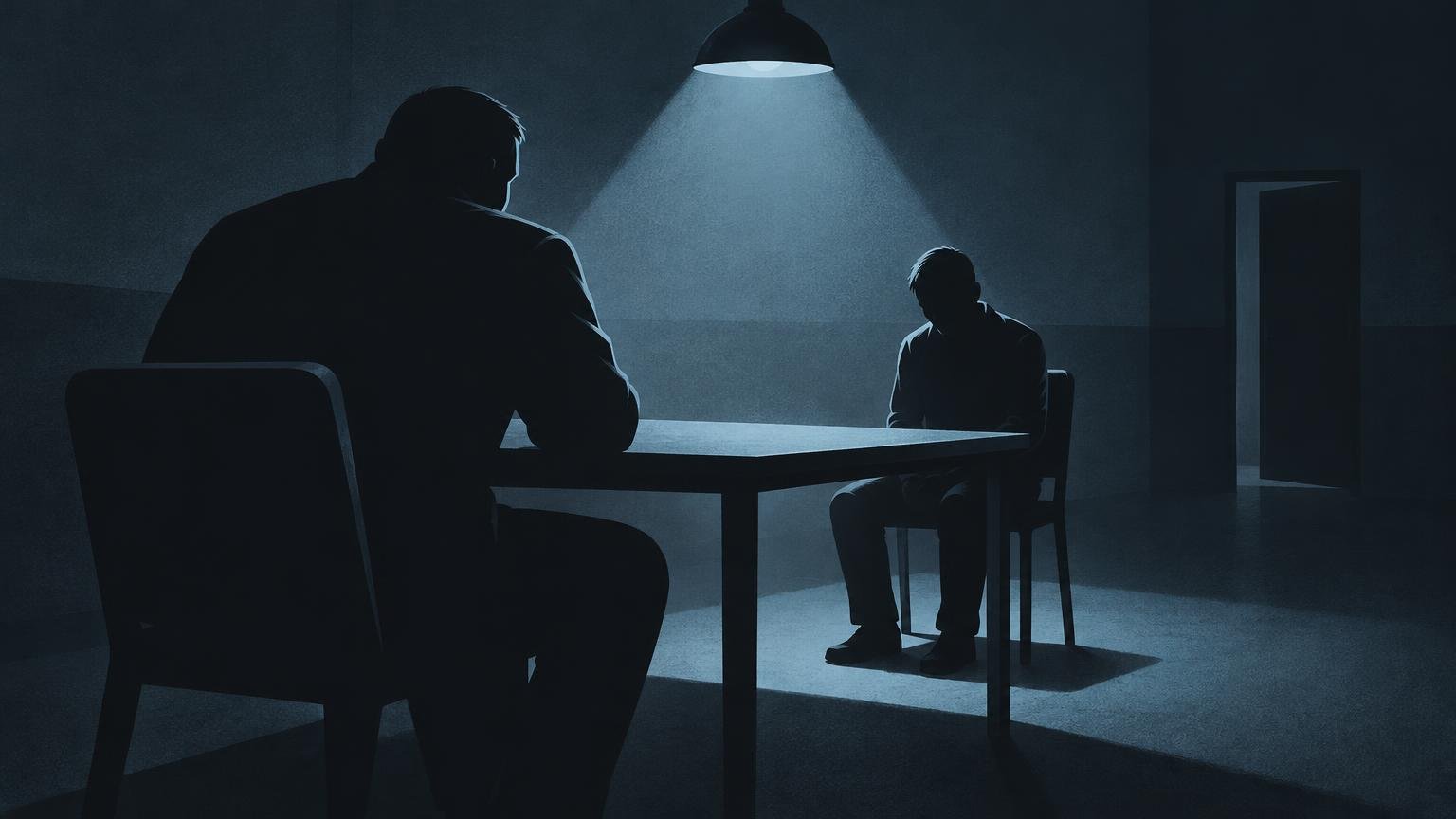
The question of why innocent people falsely confess seems to contain its own objection: no innocent person would knowingly invite prosecution and punishment. But that assumes a calm person making a free, informed decision with a clear view of the future. An interrogation can create the opposite conditions. The person may be frightened, exhausted, isolated, grieving, confused, or convinced that continued resistance will make an immediate crisis worse.
Under those conditions, confessing can become a short-term escape. A suspect may hope to stop the questioning, go home, protect another person, satisfy an authority figure, or prove innocence later. That decision can be disastrously mistaken without being incomprehensible. Research on false confessions therefore treats a confession as evidence to investigate, not a self-proving event. The decisive questions are how the statement developed, who introduced its important details, and whether evidence independent of the interrogation supports it.
Why innocent people falsely confess under pressure
False-confession research commonly describes a sequence involving misclassification, coercion, and contamination. Investigators first decide, correctly or incorrectly, that a person is responsible. That belief shapes the interview. Questioning may shift from gathering information to securing an admission, and details introduced during the process can later appear to have originated with the suspect.
Physical violence is not required to create powerful pressure. Repeated accusations, claims that the evidence already proves guilt, raised emotional stakes, long isolation, and suggestions that confession is the only sensible choice can narrow a person's perceived options. A threat can make denial appear dangerous. A promise or implied benefit can make agreement seem like the quickest route out, even when the long-term legal consequences are severe.
Two broad messages can work together. Maximization makes the situation feel hopeless: investigators may emphasize the strength of the case or the consequences of continued denial. Minimization offers a psychologically easier story, perhaps suggesting that the act was accidental, understandable, or less blameworthy than it appears. The suspect may hear an apparent invitation to accept the softer explanation without appreciating that the central admission can still be used as evidence.
The imbalance is crucial. Investigators may know the evidence, control the room, decide when the encounter ends, and repeat assertions with institutional authority. The person being questioned may know only that every denial has failed. After enough repetition, immediate relief can become more concrete than a future trial. A false confession may then be an act of compliance rather than a genuine account of a crime.
Vulnerability changes the effect of an interrogation
The same method does not affect everyone in the same way. Youth, cognitive impairment, mental illness, trauma, acute grief, intoxication, withdrawal, and difficulty understanding language or legal consequences can increase vulnerability. These characteristics do not prove that a confession is false, and they should not be used to stereotype a person as incapable of giving reliable information. They identify circumstances that require closer examination of the questioning and the safeguards used.
A young person may be especially focused on pleasing adults or ending an intolerable encounter. A person with an intellectual or communication disability may agree with propositions without understanding their significance. Someone experiencing grief or psychiatric distress may have impaired concentration. In each situation, the proper question is not whether the person belongs to a supposedly unreliable group. It is whether the record shows that a particular vulnerability affected comprehension, resistance, memory, or decision-making during this interrogation.
What sleep-deprivation research can establish
Sleep loss offers a clear example of both the value and limits of experimental research. In a controlled experiment, sleep-deprived participants were more likely than rested participants to sign a false statement admitting that they had committed a prohibited act. The experiment supports sleep deprivation as a risk factor because researchers could compare controlled groups.
It does not prove that an exhausted suspect in a real case confessed falsely. A laboratory task cannot reproduce the fear, stakes, duration, or personal consequences of a criminal interrogation. Conversely, the absence of extreme sleep deprivation does not establish that questioning was fair. Research identifies mechanisms and risk factors; the case record must show whether they were present and what effect they may have had.
How crime details can enter a false confession
A confession often appears compelling because it contains facts described as known only to investigators and the offender. Such knowledge can be important, but only if the suspect supplied the information independently. The essential question is simple: who said it first?
A detail can reach a suspect through news reports, conversations, photographs, documents left visible, leading questions, explicit correction, or information disclosed during an unrecorded part of the interrogation. It can also be added after the first admission when investigators ask the person to produce a fuller narrative. By the time a polished written or recorded confession exists, the final account may blend the suspect's words with information introduced elsewhere.
Consider the difference between an open prompt and a leading one. “Tell me what happened next” leaves the direction largely to the speaker. “You used the cord after entering through the window, didn't you?” supplies actions and objects for the person to adopt. Even subtler feedback matters. If an investigator rejects several guesses and affirms another, the accepted answer may later look like knowledge volunteered by the suspect.
This process is often called confession contamination. It does not mean that every accurate detail in a confession came from police. Nor does a detailed confession become unreliable merely because investigators asked questions. The point is evidentiary: a detail has strong diagnostic value only when the record establishes that the suspect produced it before being exposed to it.
Research reviews have found this provenance problem in documented false-confession cases. Brandon Garrett's 2026 review of 455 U.S. DNA exonerations identified 103 cases involving false confessions. His treatment of nonpublic details calls for examining possible contamination; it does not prove that officers supplied every apparently accurate fact in those cases. Exoneration records reveal known failures, not a universal rate of false confession.
What the David Vasquez record illustrates
The exoneration record of David Vasquez provides a documented example of why detail provenance matters. Records concerning his interrogation allow readers to examine instances in which details were corrected or supplied during questioning. The National Registry of Exonerations also reports that semen evidence and shoe impressions did not match Vasquez.
The lesson is not that any correction by an investigator invalidates an entire statement. It is that a final narrative cannot be evaluated responsibly without comparing it with the preceding questions. If a suspect initially gives an incorrect answer and adopts the right one only after correction, the resulting detail does not demonstrate the same independent knowledge as an accurate fact volunteered at the outset.
Independent corroboration is more than repetition
A confession becomes more trustworthy when crucial claims lead to evidence that existed independently of the questioning and was not disclosed to the suspect. Examples might include finding an object where the suspect first identifies it, verifying an unknown route, or matching a distinctive action to physical evidence. The key is independence. A police theory repeated by the suspect does not corroborate itself.
Corroboration should be tested fact by fact. Investigators and later reviewers can ask whether the information was public, whether police already knew it, whether it appeared in an earlier question, and whether the suspect supplied it without prompting. They should also look for conflicts. A confession that contradicts reliable forensic evidence, established timing, location data, or witness observations requires explanation rather than automatic deference.
Even an independently verified detail has to be weighed in context. It may strongly support access to information without proving participation in the crime. A person could know a location through prior familiarity or learn a fact from another participant. The strongest corroboration connects the confessor to the criminal act through information that was genuinely unknown, specific, and independently verified.
Why a complete recording changes the analysis
A recording of only the final confession shows the product, not the process. By that stage, the suspect may be rested, composed, and ready to repeat a narrative assembled over hours. Viewers cannot tell whether an apparently secret fact was volunteered, guessed, corrected, or disclosed earlier. The calm final statement may conceal the very conditions needed to evaluate it.
The National Institute of Justice has explained that complete recording can preserve who introduced facts, document inconsistencies and coercion claims, and protect investigators against unsupported accusations. A useful recording begins with the rights warning and continues through all substantive questioning, breaks, and the final account. The goal is not a dramatic video. It is an accurate chronology.
Complete recordings also improve review after the fact. Courts, jurors, experts, attorneys, and the public can separate open questions from leading ones, identify changes in the suspect's account, and assess whether investigators disclosed evidence. A transcript can aid close comparison, but tone, timing, interruptions, and long silences may also matter. Where possible, both the original recording and an accurate transcript should be examined.
The broader research supports moving away from confession-driven questioning. A 2024 systematic review of interview and interrogation methods examined 29 experimental studies and reported that information-gathering approaches produced more true confessions and fewer false confessions than accusatorial or direct-questioning approaches in the reviewed literature. That is a finding about the collected experimental evidence, not a verdict on any specific interview.
Legal voluntariness and factual innocence are different questions
Courts may decide whether a statement was obtained voluntarily and whether it can be admitted under governing law. Those decisions matter, but they do not necessarily resolve whether the speaker committed the crime. A confession can be excluded without establishing innocence. A statement can also be admitted without proving that every part of it is accurate.
In People v. Thomas, New York's highest court held Adrian Thomas's statements involuntary in 2014. The interrogation included threats to arrest his wife and false claims associated with the possibility of saving his critically ill child. The ruling demonstrates how documented psychological pressure can bear on legal voluntariness. It should not be converted into a general rule that every lie, emotional appeal, or threat produces a false confession.
This distinction keeps analysis disciplined. The legal question concerns constitutional and evidentiary standards. The factual question concerns what happened. They overlap, but neither substitutes for the other. Responsible case analysis reports the precise ruling and then separately evaluates the statement against the complete interrogation record and independent evidence.
How to evaluate a confession in a real case
Start with chronology rather than the final quotation. A responsible review should reconstruct the entire period of contact and answer these questions:
- When did custody or substantive questioning begin, and how long did it last?
- What opportunities did the person have for sleep, food, water, medication, legal advice, and contact with supportive people?
- Were all interviews recorded, including conversations before the formal confession?
- What were the suspect's first account and first unmistakable admission?
- Who first introduced each important crime detail: the suspect, an investigator, the media, a witness, or another source?
- Did investigators use open prompts, leading questions, corrections, false-evidence claims, threats, promises, or implied leniency?
- Which parts of the confession were confirmed by evidence genuinely independent of the statement?
- Which parts conflict with physical evidence, timing, witness accounts, or other established facts?
- What exactly did a court, jury, reviewing agency, or exoneration authority decide—and what question did it leave unresolved?
Missing footage should constrain the conclusion. If only the final statement survives, a viewer can describe what appears in that recording but cannot know how the narrative was produced. Apparent confidence, emotion, hesitation, or lack of emotion is especially easy to overinterpret. Demeanor is not a substitute for provenance and corroboration.
Databases of exonerations are valuable for finding records and identifying recurring failures, but they are not a census of every wrongful conviction or false confession. No responsible universal rate can be calculated from known exonerations alone. The cases show that false confessions occur and can contribute to convictions; they do not tell us how often every interrogation produces one.
A confession should mark the beginning of verification
An innocent confession is not rational in the comfortable, long-term sense. It can nevertheless be understandable as a decision made inside a narrowed world of accusation, fatigue, fear, vulnerability, and promised relief. The person responds to the crisis directly in front of them while underestimating—or being unable to process—the consequences waiting outside the room.
That is why the word “confession” should never end the inquiry. The strongest account is one whose path is fully documented, whose important details originated with the speaker, and whose central claims are confirmed by independent evidence. When those protections are absent, certainty should fall accordingly. The record must establish not only what the person eventually said, but how the words came to be theirs.
References
- Police-Induced Confessions, Risk Factors and Recommendations: Looking Ahead by Saul M. Kassin, Steven A. Drizin, Thomas Grisso, Gisli H. Gudjonsson, Richard A. Leo, Allison D. Redlich :: SSRN
- Frontiers | The Science-Based Pathways to Understanding False Confessions and Wrongful Convictions
- New Perspectives in policing: Policing and Wrongful Convictions
- Sleep deprivation and false confessions – PMC
- convictingtheinnocent.com
- A Vision For Justice
- David Vasquez | National Registry of Exonerations
- Interview and interrogation methods and their effects on true and false confessions: A systematic review update and extension – PMC
- People v Thomas (2014 NY Slip Op 01208)
- Explore Exonerations (Map) | National Registry of Exonerations